Friday, April 1, 2011

More of the Colonial Needle Family


White Plains, New York, headquarters for the Colonial Needle Company, is not especially noted for its balmy weather. But both Terry and Jim Collingham are gardeners and try to keep a cheerful blooming appearance at the company's back door. The picture was taken last July.

However this past winter the unusual snowfalls at times kept deliveries from the door. Jim snapped this picture after a record blizzard dropped 31 inches of the white stuff and you can tell he's disgusted. When I visited Colonial in February however, Jim was confident that there'd be no more snow because he'd purchased a monster snow blower. Today is April 1 and snow's on the way--sorry Jim!


Jim and Terry have three sons and of the trio, Tom is the one who's entered the business. Tom primarily deals with Lee's Needlearts , a Colonial Needle company specializing in hand-painted needlepoint canvases and lovely leather accessories. From purses to wallets and jewelry boxes, Lee's Needlearts products can be personalized with your own needlework.

By the way, the Lee's Needlearts website only sells wholesale but you can open and look at the color catalog and then check at your local needlework shop.

Here's the only picture I could find of Tom--as usual, he's on the phone. Above Tom's desk hangs another of Ralphie's handmade quilts.


Works of needle art hang everywhere on the walls in the Colonial Needle Company's offices. In Lucille the book keeper's neat-as-a-pin office another one of Ralphie's quilts.


A hand quilted Double Wedding Ring quilt hangs above the snack counter in the hallway that's always stocked with chocolate, pretzels, nuts, and fruit.

And these masterpiece miniature needlepoint kimonos, a Lee's specialty, on the top of the shelf over Laura's head. My apologies: Laura was busy talking to overseas customers that day so this is the only view I got of her.


Remember, if you're in need of needles, first check your local sewing supply store but if you can't find what you need locally, you can always go to Colonial's website: www.colonialneedle.com.


Sunday, March 27, 2011

Meet the Colonial Family!

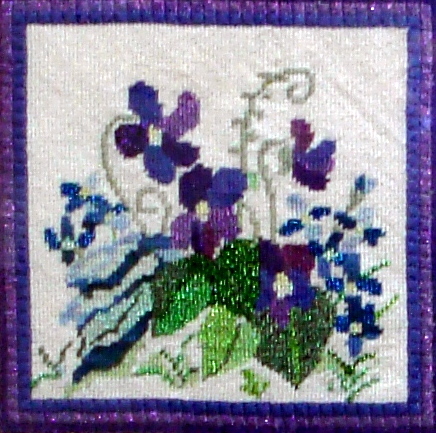
The Colonial Needle Company is the sole source of English hand needles in the United States. All the English needle brands you know--Richard Hemmings, John James, Milwards--come through this family-owned company in White Plains, New York. Primarily selling to distributors and wholesale, Colonial doesn't have much of a public face. I thought you might like to meet some of the people who make all those needles available to us and get a glimpse of what Colonial's offices are like. The little violet needlepoint picture hangs on the wall above a file case. In fact, almost every wall, with the exception of the warehouse, displays needle-made artwork.


Jim Collingham is the CEO. While I'd love to picture his office, Jim has blackmailed me NOT to show how messy his desk is. Here's his wife Terry, president and general overseer of the office, as she greets Jimmy the mailman who delivers the mail dressed for nasty wet weather. The quilt hanging behind Terry was made by her mother Ralphie and is hand-pieced and hand-quilted.


Jim and Terry are often in conference. And since Jim's office is totally jammed, this means they meet in hers.


If you call the Colonial Needle Company, the cheerful voice you'll hear might be Denise Rivera who often seems like she has more than two hands as she juggles phones and paperwork.


In the desk in the warehouse, Mike Fitzmaurice is the one who will fill your order.


And then there are the needles--millions of them! This is needle heaven.


In the next blog posting,  I'll introduce you to more of the Colonial Needle Company family such as Tom Collingham, Jim and Terry's son, who heads up the Lee's Needlarts division plus show a few more pictures of the beautiful artwork around the company offices. 

Sunday, February 6, 2011

Black and White and Red Everywhere

Work the past few days has been black and white with a spot of red. Seems those are the only colors that make sense as I put my hand to sewing projects. The picture here is Skinny Cats Valentine, a patchwork piece I drew and sewed over tracing paper. Last night it was auctioned off to raise money for the Beaufort Cat Project. The BCP's a worthy cause and keeps us from being overrun with feral cats. As a seaport city in a temperate climate, we are faced with whole colonies of ownerless kitties that are cared for by kindly folks. BCP traps, neuters, and vaccinates the wild ones who are then released and live out much healthier lives. Why not just get rid of the cats? Again, seaport with temperate climate--these guys keep down the mouse, rat, and nutria population so we're not overrun with rodents!

Valentines Day is on the brain and after talking to a friend who got a Kindle (ereader) for Christmas, I knew this sweet red leather ebook cover would be just the thing for her new toy. If you've been thinking, "I'm crafty--I ought to be able to make a cool cover for my Kindle..." look no further. Lee's Needle Arts www.newleesneedlearts.com has ebook covers in smooth red, black, and rich brown leather and some other colors (blue, tan, and hunter green) in a stylish faux-croc finish. The stock number is BAG52. The ebook covers retail for $70-$72 and if your local needlework shop does not stock them,  get in contact with Tom at 1-800-963-3353 and order one for yourself.

Each cover comes in a nice blue and white presentation box and wrapped in pretty rice paper. Put your creative urges to good use and design something spectacular for the 3" x 5" opening. Then carefully peel off the paper covering the insert, center your art work and tuck the seams (make sure to leave about 1/4" extra all around) under the stitched opening sides. I sewed my friend's initials over tracing paper 2" square blocks.


The interior of the ebook reader cover is just as nice and features a little pocket for a business card or notes plus handy elastic straps and a ledge to keep your ebook securely in place. Now you'll have the best sort of Valentines Day gift: the color you want, personalized with your own hand, and it always fits. Plus, I promise, no calories with this one!

Wednesday, November 24, 2010

The A-Word

Occasionally in a class I get a die-hard student who resists the idea of attempting any and all handwork. She calls hand quilting "a four-letter word" and applique "the A-word." Honestly, chatter about the difficulty level of these quilting skills is way over-rated! Both are quite do-able, especially if you just relax and don't hold yourself to an impossible degree of perfection. Progress, that's all I want--not perfection! That said, I did the A-word yesterday as I worked on a new class sample. Just two points of advice: use a nice strong thin needle, like a #10 Milliner (also called a Straw needle) and thread that absolutely, exactly, matches the color of the to-be-appliqued fabric. Can't miss. 


The last week in January 2011, I get the opportunity to teach quilting on Ocracoke Island.  We're making a variation of the classic North Carolina Lily pattern in our three-day workshop beginning Wednesday January 26 at the Ocracoke Community Center. My block is more of a tribute to the common Day Lily than any fancy flower. If you haven't heard of Ocracoke, this small island is about 22 miles from the mainland of North Carolina. Famous for its wild ponies and its pirate history--Blackbeard was killed there--Ocracoke is a magical place. I'll drive to the ferry at Cedar Island and about two hours, fifteen minutes later, will arrive on Ocracoke. 

For info on the upcoming class, re-named the NC Island Lily, contact Marcy Brenner, at info@coyotemusic.net. Marcy, a quilter and member of the Ocracoke Thread & Needle Club, is a musician with her partner Lou Castro. Together they are the duet Coyote and she's also the newest member of Molasses Creek. You've heard Marcy sing if you saw the movie Nights in Rodanthe. Please also email Amy Howard at wayfaringamy@embarqmail.com as a back-up since Marcy is often on the road singing.


By the way, if your local quilt store doesn't stock #10 Milliner needles, don't despair. They're available by mail order from the Colonial Needle Company at this link www.colonialneedle.com .Go to 'Hand Needles' and scroll down. 


Just for fun, I've included some pictures of other North Carolina Lily quilts, most vintage but a few modern. The red, white, and green one is from my collection and is the "ancestor" block of the pattern we'll be sewing on Ocracoke. 


Other Lily quilt pictures.


From the collection of Kathy Sullivan. This one has lots of leaves.


Here's a huge 1850s Lily quilt that I found in Southport, NC and saved from being cut into pillows! In the picture it's hanging sideways.) This antique quilt begat the piece below. I call it 'Wild Lily.' No, I am not an applique expert--will leave that to my friend Pinky Porter, who followed my pattern and did the needleturn work expertly and now it's a wall hanging. 


Monday, September 20, 2010

Permission to Work Small

    
Back in 2003,  I designed some lines of fabric for the Michael Miller company. At one trade show I went a bit overboard. I  constructed a whole doll bedroom vignette featuring wallpaper, curtains, a bed, bed ruffle, pillows, a stuffed animal in nightdress and, of course, a miniature quilt.


The tiny fussy-cut hexagons in the quilt measure only 1/2 inch on a side (finished) and I hand-pieced it using the size needle I usually use for quilt, a #10 Between. I hope I've gotten that out of my system!


     Well, maybe not. Last week I finished a tiny quilt for a stuffed teddy bear. I am NOT, repeat, NOT a doll person. But somehow I have accumulated some charming stuffed animals (I prefer to think of them as 'silent friends')) and they occupy the shelves of a cupboard here at the studio. Had no intention of making a toy quilt---it just happened. The bear was sitting in a chair and needed a quilt.

So I pieced a scrappy Streak 'o Lightning pattern quilt and quilted it Big Stitch style. The thread used is #8 perle cotton and I like either a 24 Chenille needle or a #4 Between to Big Stitch. I have no idea where the hat came from.


 I usually make big quilts, quilts large enough to wrap up in, but these toy quilts are very appealing. There's just enough work to be interesting and yet small enough that they're portable. As in, stuff the piece in a pocket and take 'em home to work on.  Small may be good. It fits my life right now. FYI: the Colonial Needle Company is coming out with an assorted pack of needles just for Big Stitch enthusiasts! Watch this blog and Colonial on Facebook for upcoming details.
    

Wednesday, August 25, 2010

The Elegant Sewing Kit (How To Keep Your Sewing Stuff in Style)

Upon laying eyes on this beautiful little box from Lee's Needle Arts, I knew it would make an elegant sewing kit. Since I love to do handwork, I'm always searching for the best box for the job. You know, something neat to keep my threads, needles-n-pins, little scissors and bits-and-pieces in. And as a frequent traveler, a well-stocked sewing box and a patchwork project in-process makes my time in-flight productive. Rather than  leafing through a ratty magazine while listening to my seat-mate snore, I can get a lot of stitching done.


The box itself measures about 2.5" deep, 4.5" wide, and 9" long. A zipper around three sides ensures all your precious stuff stays put. The "window" of the box has a paper insert in place to cover its adhesive surface until you're ready to apply your needlework. I took out the paper cover and used it as a template. 


Being very conventional, I could only think of square quilt blocks and ended up drawing a pattern for a 2.25 inch Pineapple block.  I traced the Pineapple twice onto thin white fabric, cut strips .75" wide and then sewed the little jewels by hand (used a #5 Between needle) because frankly, the starting and stopping of machine sewing just wasn't worth it. After two Pineapple blocks were joined, I framed all four sides of the rectangle with red fabric and finished the work with parallel lines of Big Stitch (a #24 Chenille needle used) on either end. Then carefully, locating the exact center of the adhesive window and the exact center of the Pineapple piece, I laid the patchwork into the window and carefully tucked in the extra fabric on all sides. Beautiful.


But I couldn't leave well enough alone! I fashioned a book-like inside that could unfold to be lifted out. And then a little star-shaped pin cushion...


When I made the tiny drawstring thimble pouch (photo at the beginning of the blog) I knew it was time to stop. 

Sunday, July 11, 2010

Basting with Thread and Needle

Food analogies come naturally to me...must be time for lunch! Basting is a term most folks associate with turkey--not today. When quilting, whether by hand or machine, I fall back on thread-basting. For me, it's the best way to ensure that all the layers of the quilt "sandwich" stay together and exactly where I want them. Basting thread is white and thus won't impart any color to fabrics as it is pulled through. Plus it's thin and when the job's done, basting thread is easy to break and pull out.


If you're a cook (still with the food thing-) thread-basting can be likened to beating cake batter: you can only rarely baste (beat) too much but you can easily not baste (beat) enough. No more lumpy quilts or cakes! Don't skimp on basting even though the process is boring. Just crank up the radio and put your brain in neutral.


When basting a quilt, the easiest method is to tape the smooth and ironed backing to table(s). Obviously, if it's a large quilt, you're going to have to shove several tables together. You can crawl around on the floor at home to baste but fortunately last Saturday I didn't even have to do that. My friend Patti, who owns ALB Fabrics, cleared her workroom and we basted my latest quilt on her tables.


First down was the blue painter's tape that holds the backing nice and taut. Next the right size batting, cut to size and smoothed over the backing.


 Followed by the quilt top, first pinned and then basted by hand using thread and needle. Finally, pins can come out and now there's a lovely soft sandwich that's much easier to handle.


After basting, the batting is trimmed to size. 


We both worked at the job but used different needles.My faves are shown left. Patti preferred an enormous needle, well, more of a spike let's say.


See the comparison photo here. My #7 Long Darner needle is about 2 1/2" long while Patti's choice, a Doll-making needle, is at least 5"!

To misquote Crocodile Dundee: "Now that's a needle!" 


Both of these basting needles are available from Colonial Needle Company mail order  www.colonialneedle.com but as always check first with your local fabric store.