Sunday, February 26, 2012

New Handwork in February


Don't get me wrong--I love printed fabric--but recently I've been experimenting with solid fabrics and even a totally different color scheme. I've been exposed to new things and to new places.


Two weeks ago I flew to Santa Fe and got to film a segment of The Quilt Show with friends Ricky Tims and Alex Anderson. The all-morning session was set within the exhibitions halls of the Museum of Indian Art & Culture. How could you not get inspired surrounded by beautiful art, baskets, weaving, and pottery? The Museum is a magical place but you can even see some of the Museum's exhibitions on the web-here's a link http://www.indianartsandculture.org/online-exhibitions  .


In the filming we talked about, and I demonstrated, two different hand techniques: sashiko (Japanese quilting) and the  folded patchwork block called Roof Tile on the Isle of Man but better-known as Log Cabin here in America.


In preparation for the filming, I made a whole wall hanging by hand. The centers of the blocks were squares of bleached vintage linen and the strips various cottons and linen-cotton blends.


Using the center large needle from the Big Stitch pack and ivory #12 perle Presencia cotton, I knew the hand stitching would show well on the dark backing fabric. After completing sixteen blocks, they were sewn in rows and all back seams appliqued together with #60 (thin but very strong) indigo thread.

On the back of the wall hanging, you can clearly see the spiral of white stitches against the indigo fabric and don't even notice that the block backings are seamed together. In researching the pattern, I've learned that the continuous spiral of stitches was considered good luck and that this trail of stitches, and quilt-as-you-go technique, is one of the primary difference between Roof Tile and Log Cabin. Other differences: the strips are folded back 1/3 at a time and there's no batting needed in this quilt.

Some quilt historians theorize that Roof Tile is actually the English ancestor of Log Cabin and the fact that we can't accurately document any American Log Cabin quilts older than the late 1850's does indeed suggest Roof Tile might have migrated with settlers to the United States. Many people from Ireland, the Isle of Man, and northern England arrived here between 1820 and 1860 and brought their skills and culture with them.

What Americans added to this quilt pattern is typical--we turned it into a one-layer patchwork pattern like the other quilts we were used to making and gave it a familiar name. The log cabin was already an American icon by 1850 and several presidential candidates, from Harrison to Lincoln, would use the log cabin as a symbol in their campaigns to illustrate their humble roots. "Born in a log cabin on the frontier-" offered proof of a candidate's humble beginnings and even suggested that he would bring a fresh non-politician's view to the office. Sometimes I wonder if times have really changed that much!

Friday, November 11, 2011

New Work

Quilt Market (a trade show held every year in Houston, Texas) and its adjunct event, the International Quilt Festival, usually wears me out. It stretches into ten solid days of talking, exhibiting, selling, teaching, looking at the quilts, and meeting people from all over the world. I get home totally knackered and need a week to get right. But somehow this year, I came back strangely energized. Among the trends I noticed was the use of textured fabric in quilts, especially linen, and I was eager to try it myself.

Sashiko, the traditional quilting of Japan, looks especially appropriate on linen. And this year I had new sashiko stencils with Quilting Creations International as well and couldn't wait to try those in stitches.Here's the link to that page-- Quilting Creations

  Among the new stencils is a Sashiko Valentine (PCW113). When I drew the Valentine, I'd been careful to use traditional sashiko patterns that convey good wishes. In the heart, the waves represent eternity, the hexagons (tortoiseshell) long life, and the asanoha (the six-point star shape) stands for good health.  The rabbit is a traditional symbol for love and the heart is, well, a heart.

I got some lovely oatmeal-color textured linen from my friend Patti Brown who owns ALB Fabrics and the Quilted Butterfly
then marked the Valentine stencil with a white Roxanne pencil and sat down to stitch. The needle was the largest needle from the middle of the Sashiko Needle Sampler from Colonial Needle Colonial Needle and the two threads both #8 perle cotton by Presencia. The red is #1166 Bright Red and the blue is #3327 Dark Navy.

After stitching, the piece was trimmed and I machine-basted a line of large stitches about 5" out from the perimeter of the design. Cutting a 10 x 14 piece of thin batting, I glued it to a ready-made canvas, positioned the sashiko piece, and stapled it around to the back of the canvas. Somebody very special is going to get a stitched Valentine this year.


I signed it lower right with an X and O for hug and kiss--that's not on the stencil--you'll have to add your own!

Wednesday, October 26, 2011

Two for the Show

The past month I've been getting ready for the International Quilt Market which is held annually in Houston, Texas. Quilters, teachers, stitchers, shop owners, manufacturers of thread and fabric from around the world will be in attendance. Last year over 3500 people attended and that's not counting the hundreds of exhibitors! Preparing for this event almost always means making some new samples and I have a couple to share.


The first is outline embroidery of a chrysanthemum. Outline embroidery is done in the stem stitch. When worked in red thread, the technique is called Redwork but here there is a combination of red and green suitable to the flower design. The mum is a classic design and I found it in a reprint of Ruby Short McKim's Flower Garden series which ran in the Kansas City Star newspaper in 1930. Ruby's granddaughter heads the McKim Studios website today. The whole series for the Flower Garden quilt is available from the website in a beautifully printed little book. http://www.mckimstudios.com/04treasures/quiltspecial/flowergardensamples.shtml .

The thread? Both the rusty red (color #1490) and deep green (color #4371) are worked in double-strands of embroidery floss. The brand is Finca Mouline by Presencia and you can see the floss color chart at the Presencia online catalog http://www.presenciaamerica.com/ . There's also a handy conversion chart for Presencia/DMC so if you know your DMC color #, you can find its equivalent in Presencia http://www.wonderfil.net/dmc.htm . The fabric in the chrysanthemum stitchery is vintage linen and the plaid is upcycled from a linen shirt.


The second sample is a Crazy Quilt block out of my imagination. Fabrics include silk, cotton, homespun plaid, and a batik. Threads used were the Presencia floss in ivory (color #3000), palest sage green (color #5051), and bright gold metallic floss (color #0009).


For both of these embroidery works, I used embroidery needles by John James. The picture here is only of size 7 but for multiple threads ,try the 3-9 Embroidery needle assortment since you're sure to find the right size needle for most embroidery projects.

Quilt Market's around the corner and with hundreds of vendors and thousands of people coming from around the world, it's sure to be a great time. Stop and say hello if you're attending. The Colonial Needle Company and Presencia Thread will be in these endcap booths: 608-708 and across the aisle, 709-809.


Friday, September 2, 2011

Utility Stitch, Long Stitch, whatever--it's still Big Stitch!


We usually do Big Stitch quilting today because we like the visual effect of the larger stitches. But in the past, when making a quilt from very heavy materials, Big Stitch was likely the only way to hold thick layers together. Recently I bought this old wool scrap quilt on ebay--talk about thick! If this quilt was on your bed, you might have trouble turning over.


This must have been a bear to work on--notice how super-frugal she was--she even pieced the taupe center square--twice!

.
The quilt is all very rough wools, a few bright colors, and even some old army blankets. The top features string-pieced long hexagons between the squares. Most of the squares have this simple four-leaf shape stitched in them and then additional quilting between the squares--certainly enough to hold the piece together. The thread used was heavy perle cotton in multiple colors. She likely used what she had on hand.


But Big Stitch can also be embellishment and this summer, I finished a quilt top that needed just that touch--a line of black Big Stitching around the border. You know you have a lot of fabric when you can make an all- green charm quilt and never have to ask your friends for donations! While a wild bias-stripe in olive-and-black seemed just the right frame for the piece, I'm happier now with Big Stitching that helps define the outside wavy edges of the Apple Core shapes appliqued onto the border strips.


Here's the whole quilt against the back fence as my friend Fran and Mary try to hold it down so I can take the  picture.


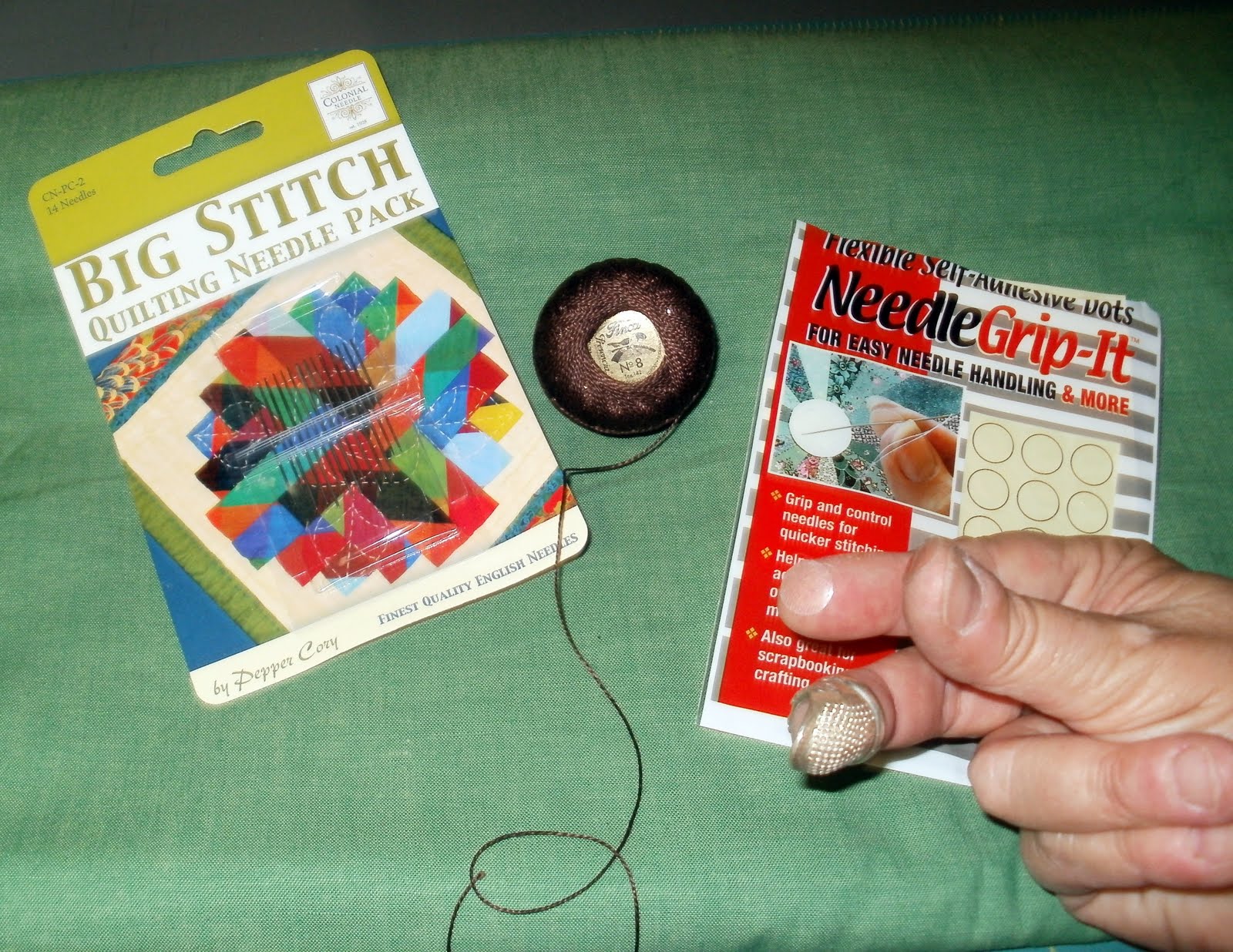
And here are my supplies for a session of Big Stitch quilting on a heavy quilt. The right needles-check. A ball of #8 perle cotton-check. On my middle finger my heaviest thimble (a silver Roxanne) and to better grasp the needle,  two little dots of Needle Grip-Its are stuck to my thumb and forefinger. I can stitch through steel now!

Saturday, May 21, 2011

Sew Happy Together


In a marriage made in needleworker heaven, the Colonial Needle Company is happy to announce that it has bought the Presencia Thread Company USA. Be still my heart! Less than four weeks ago while teaching in the Denver, Colorado area I went to Presencia in Evergreen with my friend Cindy Brick. It was a courtesy call to see my friend Karlin Allen who has been my designer liaison whenever I needed #8 perle cotton for Big Stitch kits or to do sashiko. Somehow, Karlin didn't let the cat out of the bag when I was there although she knew the sale was imminent.


The Presencia warehouse holds thousands of skeins and spools of thread. Envision the ironic last scene from the movie Raiders of the Lost Ark where the guy's trundling the Ark off to storage and you get the picture--thread, as far as the eye could see.


While I didn't give in to my animal instincts--to run in circles and whoop for joy--you'll have to believe when I say that's truly how I feel about this sale. Needle-plus-thread. Wonderful. Both companies will get better but most of all, needleworkers will benefit since their beloved supplies and notions will be available from one source.

The timeline's still in play but if all goes right, Presencia Threads USA will move to the Colonial Needle Company's home address in White Plains, New York by the end of June and hopefully be up and integrated into the Colonial family system in July. It's a big job--storage units in, dropped ceilings out, offices moving to the second floor as the first floor fills up with thread.


FYI: Presencia USA is the American office of Presencia Threads from Valencia, Spain. The company has been in business since 1949 and is acknowledged as the supplier of superior embroidery and sewing threads. You know their products even if you've never bought a spool of their thread. Presencia Threads are used in many high-quality clothing lines.


Tuesday, May 10, 2011

Big News! And what you'll want to put on your Christmas wish list this year

Big Stitch needles are here--yippee--I have been waiting for this one! The boxes of Big Stitch needle packs  arrived from England and Colonial Needle is shipping them out to distributors and shops ASAP. There's fourteen needles in the pack and represent four different sizes of needles. The pack retails for $7.30. Ask at your local quilt shop or if you cannot find them, try the Colonial Needle's website store at www.colonialneedle.com.

Why the variety? People like to use different thicker threads to do Big Stitch and we wanted to offer needles for them all. You can use doubled quilting thread, a #8 perle cotton (the most common thread used). a #5 perle (thicker for a really visible stitch), or even a #12 perle, a thinner but still a "make a statement" thread. Our feedback finds that lots of people are first quilting by machine along easy to follow seam lines in their patchwork but then coming back and adding Big Stitch quilting where it shows best. No sense in hiding these stitches--it's quilting with an ATTITUDE.

Also upcoming is a sweet little zippered box from Lee's Needle Arts. I predict that The Elegant Sewing Box will become your favorite take-along sewing accessory. It comes in either classic black or red faux croc-grain leather and you get to personalize the box cover with your own needlework. The inside of the box is lined with  ivory flannel and large enough to accommodate even a full-size pairs of scissors, your needles, thread, and a small project. The box retails for $49.95.

If you're a little OCD, you can make a Log Cabin insert with less than 1/4" wide strips of silk. Or try the Crazy Quilt patch that comes as a free pattern when you buy the box.  Of course you could also do any sort of needlework such as needlepoint, sashiko, or cross stitch in the top.

The Elegant Sewing Box would be an excellent addition to your wish list. What list? You know, that list you hand a family member the day after Thanksgiving or when your spouse says, "What would you like for your anniversary?"  Much nicer than an anonymous gift certificate but cheaper than the latest Bernina. Your family members will appreciate your thoughtfulness!

Friday, April 1, 2011

More of the Colonial Needle Family


White Plains, New York, headquarters for the Colonial Needle Company, is not especially noted for its balmy weather. But both Terry and Jim Collingham are gardeners and try to keep a cheerful blooming appearance at the company's back door. The picture was taken last July.

However this past winter the unusual snowfalls at times kept deliveries from the door. Jim snapped this picture after a record blizzard dropped 31 inches of the white stuff and you can tell he's disgusted. When I visited Colonial in February however, Jim was confident that there'd be no more snow because he'd purchased a monster snow blower. Today is April 1 and snow's on the way--sorry Jim!


Jim and Terry have three sons and of the trio, Tom is the one who's entered the business. Tom primarily deals with Lee's Needlearts , a Colonial Needle company specializing in hand-painted needlepoint canvases and lovely leather accessories. From purses to wallets and jewelry boxes, Lee's Needlearts products can be personalized with your own needlework.

By the way, the Lee's Needlearts website only sells wholesale but you can open and look at the color catalog and then check at your local needlework shop.

Here's the only picture I could find of Tom--as usual, he's on the phone. Above Tom's desk hangs another of Ralphie's handmade quilts.


Works of needle art hang everywhere on the walls in the Colonial Needle Company's offices. In Lucille the book keeper's neat-as-a-pin office another one of Ralphie's quilts.


A hand quilted Double Wedding Ring quilt hangs above the snack counter in the hallway that's always stocked with chocolate, pretzels, nuts, and fruit.

And these masterpiece miniature needlepoint kimonos, a Lee's specialty, on the top of the shelf over Laura's head. My apologies: Laura was busy talking to overseas customers that day so this is the only view I got of her.


Remember, if you're in need of needles, first check your local sewing supply store but if you can't find what you need locally, you can always go to Colonial's website: www.colonialneedle.com.